Why AI can’t steal a soul.
On why the machines can copy our brushstrokes, our styles and our design systems, but they’ll never inherit our heartbreaks.
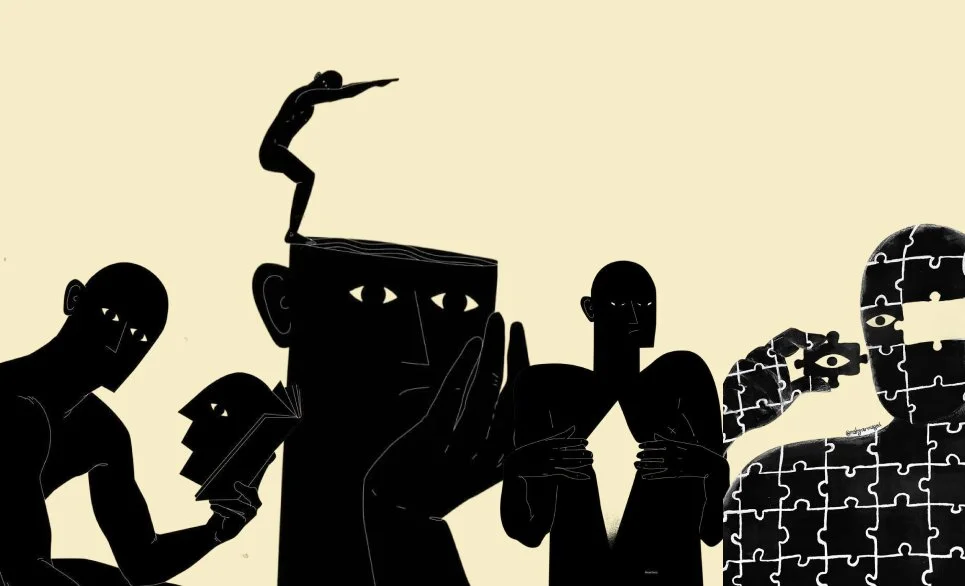
Photo Illustration by Emil Lendof/The Daily Beast
We’re staring at the monitors as we watch the time tick closing in our deadline. The room is quiet, save for the hum of the HVAC and the frantic clicking of a mouse. We’re watching our youngest designer use an AI model to prompt an entire corporate visual identity into existence.
It took forty-five seconds.
Forty-five seconds for a (somewhat) pristine logo, a primary palette, four secondary variations, and a fully rendered mockup of a storefront that looks so clean it makes your teeth hurt. We remember when that used to be a three-week knife fight with clients and a mountain of burned-out nights. Now? It’s just another line item completed before the coffee gets cold.
We’ve officially arrived. The machinery of creation has become entirely frictionless. The barrier to entry hasn't just been lowered; it’s been vaporized. If a business wants something beautiful, they don't need a tortured creative agency anymore. They just need a prompt and a decent internet connection.
But at tbdco, we aren't panicking. Because here’s the reality they don’t tell you in the tech keynotes: when everyone has access to a magic wand, magic becomes the baseline. It becomes completely, utterly boring.
Let's talk about what's actually happening out there in the trenches, and why the robots aren’t going to save us from our own mediocrity. And it all starts with being honest.
Here’s the bare truth about the grunt work of design. It’s tedious. Sometimes its cooking up thought through strategy for a brands new facelift, sometime it’s assimilating a complex design system for a fin-tech brand, sometimes it’s resizing banners for sixteen different social media platforms. It’s isolating a product image from a messy background. It’s generating forty variations of a landing page button to see which one makes people click 0.4% more often.
For tbdco, AI is the greatest intern the world has ever seen. It doesn't sleep, it doesn't complain about the briefs, and it pushes pixels at the speed of light.
The Commodity of the Aesthetic: Beautiful vector work, flawless 3D renders, and perfectly balanced layouts are now cheap. They are a utility, like electricity or running water.
The End of the Grunt Work: If an agency's entire value proposition was built on knowing which keyboard shortcuts to hit in Illustrator to make a shape look pretty, they are dead in the water. The machine owns the execution now.
But execution is just the hands. And hands without a brain are just flailing in the dark.
You can feed an algorithm every piece of data in the history of consumer psychology, and it will still never understand what it feels like to be human. It doesn't know the quiet desperation of a failed venture, the specific joy of a stupid inside joke, or the sting of a bad review.
And that is exactly what branding is. It’s an emotional transaction.
Strategy isn’t a math problem to be solved by data; it’s an argument. It’s about taking a stand. At tbdco, we believe in having the intuition to look at what the data says you should do, and sometimes having the guts to go the opposite direction because you know it will make people feel alive.
The human role now isn't to draw the lines, it’s to decide where the lines matter.
The Power of Irrationality: Great brands are built on weird, irrational human choices. An AI would optimize those raw, polarizing ideas right out of the room because they don't make sense on a spreadsheet.
Context and Culture: A machine can look backward at what worked yesterday, but it cannot feel the cultural zeitgeist shifting tomorrow. It doesn't have skin in the game. We do.
Here’s what businesses should actually expect. If you’re running a business, stop looking for an "AI solution" that lets you fire your creative partners. That’s a sucker's bet. Instead, you need to change your expectations of how the game is played.
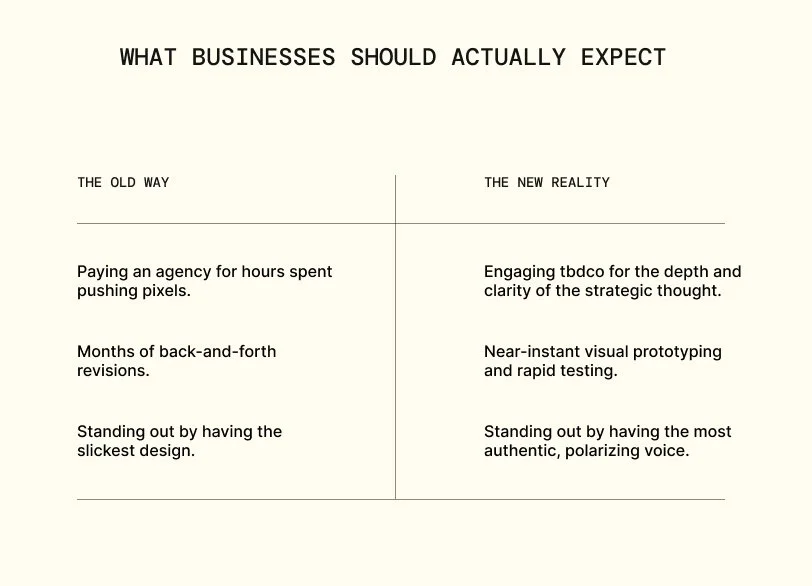
Expect things to move faster. Expect the cost of making stuff to drop to near zero. But expect the cost of standing out to skyrocket. When the market is flooded with a million perfectly designed, AI-generated brands, the only ones that will survive are the ones that possess a distinct, un-copyable human perspective.
Now here’s the bottom line: We’re not replacing creativity; we’re finally liberating it.
For a long time, the industry confused craftsmanship with art. We thought that because someone could draw a perfectly straight line, they had something important to say. AI has exposed that lie. The machine can draw the line better than any human ever will.
So what’s left? The soul. The scars, the obsessions, the weird taste, and the willingness to say something that might actually cause a stir.
The machines have taken over the factory floor, and thank goodness for that. Now tbdco is going upstairs to figure out what we actually want to say.